
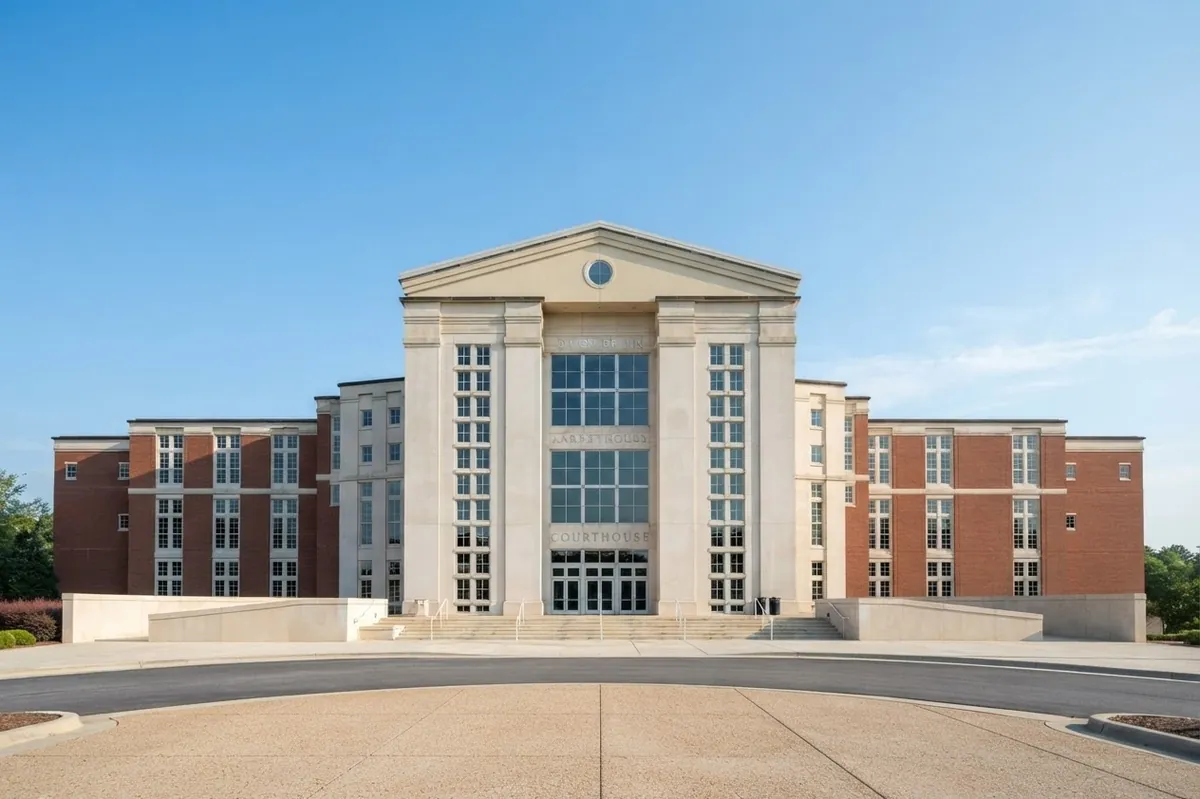
Court records in Harnett County, North Carolina, are maintained by the Clerk of Superior Court and can be accessed through online tools, official court portals, and the clerk's office. HarnettCourt.us can help you find publicly available court record information for Harnett County. You can also use the North Carolina Judicial Branch's Harnett County page, the statewide eCourts portal, or visit the clerk's office in person to search for case records, look up court dates, and request copies of filings.
Harnett County Court System Overview
Harnett County is part of North Carolina Judicial District 11, which also includes Lee and Johnston counties. The court system in Harnett County operates as a unified General Court of Justice under North Carolina law, with a Superior Court division handling felonies and higher-value civil matters and a District Court division hearing misdemeanors, infractions, family law, juvenile cases, and civil cases up to $25,000. Magistrates serve under the District Court and handle small claims, issue warrants, set bail, and perform other initial judicial functions. The Harnett County Courthouse is located in Lillington, the county seat.
Courts Serving Harnett County
| Court | Address | Phone |
|---|---|---|
| Harnett County Superior Court | 301 W. Cornelius Harnett Blvd., Lillington, NC 27546 | (910) 893-3400 |
| Harnett County District Court | 301 W. Cornelius Harnett Blvd., Lillington, NC 27546 | (910) 893-3400 |
| Harnett County Magistrate's Office | 175 Bain Street, Lillington, NC 27546 | (910) 893-3400 |
| U.S. District Court, Eastern District of North Carolina | 310 New Bern Avenue, Raleigh, NC 27601 | (919) 645-1700 |
| U.S. Bankruptcy Court, Eastern District of North Carolina | 310 New Bern Avenue, Raleigh, NC 27601 | (919) 856-4752 |
Harnett County does not have a separate municipal court. All state-level criminal, civil, and family matters are heard in the Superior or District Court divisions at the Harnett County Courthouse. Federal cases involving Harnett County residents are filed in the Eastern District of North Carolina, based in Raleigh.
What Types of Cases Harnett County Courts Hear
Courts in Harnett County handle a broad range of case types across the Superior Court, District Court, and Magistrate divisions:
- Criminal: Felonies, misdemeanors, infractions
- Civil: General civil litigation, small claims, summary ejectment (eviction)
- Family Law: Divorce, child custody, child support, domestic violence protective orders, paternity, termination of parental rights
- Probate and Estates: Decedent estates, guardianships, incompetency proceedings, trusts
- Juvenile: Delinquency, undisciplined youth, abuse/neglect/dependency
- Traffic: Moving violations, DWI, license-related offenses
- Adoption
The sections below break down which court division hears each type of case.
District Court Cases in Harnett County
Harnett County District Court judges hear misdemeanor criminal cases, infractions, and all traffic matters. The District Court also has exclusive jurisdiction over family law cases — including divorce, custody, child support, and domestic violence protective orders — as well as juvenile proceedings. Civil disputes where the amount in controversy is $25,000 or less are tried in District Court without a jury. District Court judges preside over these matters, and cases typically arrive through criminal citations, civil complaints filed with the clerk, or petitions in family and juvenile matters. Appeals from magistrate decisions in small claims or summary ejectment go to District Court for a new trial.
Magistrate Court Cases in Harnett County
Magistrates in Harnett County are judicial officers within the District Court division. They handle:
- Small claims — civil disputes up to $10,000
- Summary ejectment (eviction) actions
- Worthless check cases under a certain threshold
- Criminal process — issuing arrest warrants, search warrants, criminal summonses, and setting conditions of pretrial release
- Initial appearances for arrested individuals
Magistrates do not conduct jury trials. Either party in a small claims or summary ejectment case may appeal to District Court for a trial de novo within 10 days of the magistrate's judgment. Magistrates are available around the clock for warrant and bail matters.
Family Law, Probate, and Juvenile Matters in Harnett County
Family Law: Divorce, equitable distribution, alimony, child custody, child support, paternity, and domestic violence protective order cases are all heard in Harnett County District Court. North Carolina requires at least one year of separation before filing for absolute divorce. The NC Judicial Branch offers a free divorce packet to help self-represented litigants prepare their filings. Divorce certificates can be obtained from NC Vital Records or from the Clerk of Superior Court in the county where the divorce was granted.
Probate: The Clerk of Superior Court in Harnett County acts as the judge of probate, overseeing the administration of decedent estates, appointment of executors and administrators, guardianships, and incompetency proceedings. Filings are made at the clerk's office in the courthouse.
Juvenile: Juvenile cases — including delinquency, undisciplined conduct, and abuse/neglect/dependency petitions — are heard in District Court. Juvenile court records are confidential under North Carolina law and are not available through public search portals. The Guardian ad Litem program serves children in abuse and neglect proceedings; information on the local GAL program is available through the Harnett County court page.
How Cases Move Through the Harnett County Court System
- Filing or initiation: Criminal cases begin with a magistrate's order, arrest warrant, or grand jury indictment. Civil cases start with a complaint filed with the clerk. Family and juvenile matters begin with a petition.
- Assignment: Cases are assigned to a judge based on the court division and the session calendar. Superior Court sessions are scheduled for specific weeks; District Court holds regular sessions throughout the term.
- Initial hearing: Criminal defendants have a first appearance or arraignment. Civil cases receive a scheduling order or are calendared for a hearing. Family cases may have a temporary hearing for custody or support.
- Pre-trial phase: Parties exchange discovery, file motions, and may engage in mediation (required in most custody disputes). Criminal defendants may negotiate plea agreements with the district attorney.
- Trial or resolution: Cases are resolved by plea, bench trial, jury trial, settlement, consent order, or default judgment.
- Post-judgment: Criminal cases proceed to sentencing. Civil judgments may be enforced or appealed. Appeals from District Court go to Superior Court; appeals from Superior Court go to the North Carolina Court of Appeals.
Court Administration, Local Rules, and Public Access in Harnett County
The Administrative District Judge for Judicial District 11 oversees court operations in Harnett, Lee, and Johnston counties. A Trial Court Administrator supports day-to-day scheduling, personnel, and facilities management. Contact the Harnett County court offices for the current trial court administrator's phone number and email.
Local rules: Each judicial district may adopt local rules governing scheduling, motions practice, and courtroom procedures. Local rules for District 11 are available through the clerk's office or the NC Judicial Branch website.
Public access to records: Under North Carolina General Statutes Chapter 132 (Public Records Act) and judicial branch policies, most court records are open to the public. Exceptions include juvenile records, adoptions, involuntary commitment proceedings, sealed records, and certain records in cases involving trade secrets or victims of sexual offenses. You can access case information through the statewide eCourts system, which was fully implemented across all 100 North Carolina counties as of October 2025. Public self-service terminals are also available at the clerk's office.
Attending hearings: Most court sessions in Harnett County are open to the public and held in person at the courthouse. Some proceedings may be conducted by video or telephone at the court's discretion. Check the court dates search tool for scheduled hearing times.
Court Records and Related Court Resources in Harnett County
- Court record search: Use the NC Courts Portal to search for case records, court dates, and filings statewide, including Harnett County cases. The eCourts platform provides electronic access to case documents.
- Court calendar and hearing schedule: Search upcoming court dates by name, case number, county, or date range.
- Court forms and self-help: The NC Judicial Branch provides court forms and a Guide & File tool for certain case types, including divorce.
- Clerk of court and public records requests: Visit the clerk's office at the Harnett County Courthouse to view paper files, use a public terminal, or request certified copies. You can also submit a public records request through the NC Judicial Branch.
- Obtaining court records: For details on how to access criminal and civil case records, including in-person and online options, see the NC Judicial Branch's guide to obtaining court records.
- Offender and inmate search: The North Carolina Department of Adult Correction provides an offender search tool covering state prison inmates, probationers, parolees, and registered sex offenders. Harnett County is also home to Harnett Correctional Institution, a medium-custody state prison facility.
- Sex offender registry: Search the North Carolina Sex Offender Registry maintained by the NC State Bureau of Investigation.
- Vital records: Birth, death, marriage, and divorce records are maintained by NC Vital Records. The Harnett County Register of Deeds also issues marriage licenses and maintains local vital records.
- Sheriff's Office: The Harnett County Sheriff's Office provides law enforcement services and publishes a wanted persons list on its website.
- Department of Public Safety: The NC Department of Public Safety oversees emergency management, law enforcement training, and other public safety programs across the state.